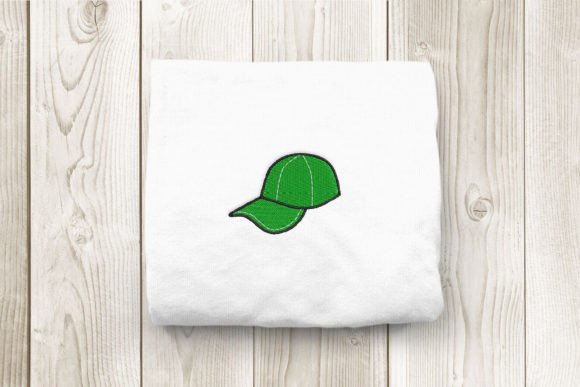
Angled Baseball Cap Mini
As an embroidery designer who’s prepped over 200 craft fair booths—and shipped thousands of embroidery files to Etsy sellers, boutique makers, and small shop owners—I opened Angled Baseball Cap Mini with one question: “Will this stop someone mid-aisle?” The answer? Yes—but only if placed intentionally.
A First Impression That Leans Modern & Playful
The title alone signals movement: “angled” implies energy, not static symmetry. It’s not a flat-front cap—it’s tilted, confident, slightly cheeky. Visually, it reads as modern-casual rather than sporty or vintage. Think farmhouse-chic coffee shop apron, not Little League gear. It lands somewhere between minimal and decorative—clean enough for a linen tea towel, expressive enough for a patch on a denim tote. No florals, no script, no glitter—it’s a quiet statement piece with personality.
Where Angled Baseball Cap Mini Shines (and Where It Doesn’t)
This machine embroidery design thrives where contrast and context do the heavy lifting:
- Tote bag design: Centered on a natural canvas or oatmeal linen tote, it reads instantly—even from six feet away. The angle creates visual flow; customers’ eyes follow the brim upward. Perfect for booth signage or as a subtle brand marker on the lower corner.
- Apron embroidery: Ideal on the chest pocket or lower left front panel. Its compact scale avoids overwhelming the wearer while adding handmade charm. Works especially well on unbleached cotton or chambray—fabrics that let stitch texture breathe.
- Tea towel embroidery: A single Angled Baseball Cap Mini near the hem (not centered) feels intentional, not busy. Avoid pairing it with dense border motifs—let it stand alone as a focal point.
- Embroidered patch: This is where it truly sings. Stitched onto twill or felt, heat-sealed or sewn, it becomes a collectible. Craft fair shoppers love patches for jackets, bags, and planners—and this one has instant recognition without needing explanation.
- Fabric pouches & pillow covers: On 6”–8” pouches, use the medium size. On 16”–18” pillow covers, go large—but only if the background fabric is smooth and light-to-midweight. Dense textures like burlap or thick terry will mute the bean-stitch outline on smaller sizes.
It’s less effective on curved surfaces like actual baseball caps—unless you’re using specialized cap hoops and foam stabilizer. And while it *can* go on dark fabric, test thread contrast first: light gray or ecru thread on navy reads softer than stark white, which risks looking harsh.
Production Realities: Speed, Clarity, and Batch Confidence
What makes Angled Baseball Cap Mini a strong craft fair product isn’t just aesthetics—it’s practicality. The design is immediately legible at a glance. No decoding required. That’s critical when your booth has 30-second customer interactions and you’re stitching 40+ items in two days.
It scales cleanly: the switch to bean stitch on the two smallest sizes is smart—not a compromise, but a functional adaptation. Bean stitch holds up better on tight curves and thin fabrics (like tea towel hems or patch backing), reducing puckering and thread breakage during high-speed runs.
For batch production? Highly repeatable. Low stitch density (no dense fill areas or micro-lettering), consistent line weight, and balanced negative space mean fewer tension adjustments across machines. You can confidently run 50+ units on mid-range commercial or home embroidery machines—provided hoop size matches your frame (check your file specs before loading).
Careful-Use Notes Every Designer Should Check
Even a clean design needs scrutiny. Before cutting fabric or uploading to your embroidery software:
- Test Angled Baseball Cap Mini on scrap fabric matching your final product’s weight and texture—especially for tea towel embroidery or apron embroidery, where loop pile or slub can distort fine lines.
- Review spacing: Does the brim clear the edge on your chosen hoop size? Tight margins on small pouches or pillow covers may require repositioning or resizing.
- Inspect stitch density in the crown area—if your file includes subtle shading or layered satin, confirm it won’t sink into thick stabilizer or bleed on dark fabric.
- Use cutaway or tear-away stabilizer based on fabric stretch—not guesswork. Lightweight cottons need more support than structured twill.
- Create at least one real mockup—not just a printable mockup. See how it photographs under natural light and booth lighting. Does the angle pop? Does the bean stitch read as intentional detail or “fuzzy”?
- Compare thread colors across fabric swatches. A warm beige thread on cream linen reads cozy; the same thread on ivory polyester may disappear.
- Confirm commercial licensing status. As a digital embroidery file, Angled Baseball Cap Mini must be cleared for resale in finished products—especially if you’re listing embroidered caps or patches on Etsy or wholesale to boutiques.
Why It Strengthens Your Booth—and Your Brand
In a sea of florals and quotes, Angled Baseball Cap Mini adds visual rhythm and subtle wit. It doesn’t shout—it invites curiosity. Customers pause, tilt their heads, smile. That micro-moment builds connection. On a display table stacked with handmade product variety—tote bags, aprons, tea towels, patches—it acts as a stylistic anchor: modern, grounded, and unmistakably crafted.
It also reinforces perceived value. Because it’s not generic clip art, buyers subconsciously register effort—thoughtful scaling, intelligent stitch choices, intentional placement. That translates to higher price tolerance and stronger repeat interest. For Etsy sellers, it’s a standout thumbnail. For boutique makers, it’s a signature motif that fits across categories without feeling repetitive.
Bottom line: Angled Baseball Cap Mini isn’t just another embroidery file. It’s a versatile, booth-ready design asset—one that balances charm with clarity, simplicity with distinction. Use it right, and it won’t just sell. It’ll start conversations.