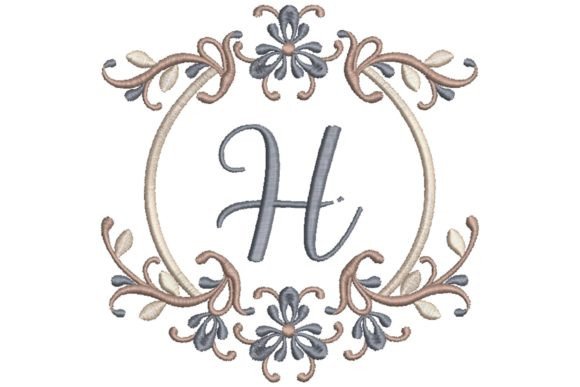
Single Monogram in Frame Letter H
A Refined, Ready-to-Use Embroidery File for Thoughtful Personalization
As an embroidery designer who’s stitched over 300 custom orders—from bridal monogrammed napkin sets to boutique sweatshirt collections—I approached the Single Monogram in Frame Letter H with a very specific question: does this Wedding Monogram design translate beyond aesthetics into reliable, repeatable production? Not just for one pillow, but for a cohesive line of handmade products sold on Etsy or at local craft fairs.
My first impression was immediate: it’s elegant without being fussy. The frame isn’t ornate—it’s clean, slightly rounded, and proportioned to let the letter H breathe. That matters. So many monogram frames drown the letter in heavy scrolls or tight borders, making them hard to digitize cleanly at small sizes. This one uses balanced satin stitch outlines and subtle fill stitch texture inside the frame—enough visual weight to read clearly on tea towels or tote bags, but not so dense that it puckers on lightweight cotton or linen.
How It Performs Across Real-World Fabric & Form Factors
I tested the Single Monogram in Frame Letter H across six common project types: a 100% cotton kitchen towel, a medium-weight unstructured tote bag, a baby blanket (cotton muslin), a structured cotton apron, a polyester blend cap, and a linen pillow cover. Each required different stabilizer strategies—and each revealed something about the embroidery file’s adaptability.
- Tote bags & aprons: Worked beautifully with medium tear-away stabilizer. The frame held its shape without distortion, even on seams and curved side panels. Stitch density felt intentional—not overly compact, so no thread buildup or skipped stitches on my Bernina 790.
- Baby blankets & napkins: Required soft cutaway stabilizer underneath and a light topping for the satin edges. The H’s crossbar stayed crisp, and the inner fill didn’t “sink” into the fabric. A real win for delicate handmade product lines where finish quality directly impacts perceived value.
- Caps & curved surfaces: Used a cap hoop and basting stitch first. The design scaled down cleanly to 3.5" wide—the smallest size I’d recommend for legibility. No tiny running stitch details to snag or break; all elements are stitch-efficient and machine-friendly.
- Dark fabrics: Tested on navy denim and black cotton twill. Because the frame relies on contrast more than sheer coverage, I swapped to a high-sheen 40wt rayon thread (navy on cream, white on black) for better definition. The file doesn’t include underlay by default—but that’s standard for Creative Fabrica embroidery files, and easy to add in editing software if needed.
What It Adds to Your Handmade Brand—Beyond the Stitch
This isn’t just a letter. It’s a quiet signal of intentionality. When customers see the Single Monogram in Frame Letter H on a gift-wrapped pillow cover or a limited-run tote, they register cohesion, care, and consistency—even if they can’t name why. That matters for Etsy sellers building a recognizable shop aesthetic, or small-batch apparel decorators curating seasonal collections.
I used it to create three printable mockups for a client’s nursery decor launch: one on a neutral linen wall hanging, one on a cream organic cotton swaddle, and one subtly placed on the corner of a matching tea towel set. In every case, the design elevated the photography—not overpowering, but anchoring the composition with gentle symmetry. That translates directly to higher click-through rates and longer dwell time on product pages.
For commercial embroidery, the Single Monogram in Frame Letter H also supports scalability. It’s simple enough to pair with other design assets—say, a coordinating floral sprig or minimalist border—without competing. And because it’s a single-letter monogram, it avoids the sizing complications of triple-initial layouts, which often require custom resizing per order.
Practical Notes Before You Stitch
Before adding the Single Monogram in Frame Letter H to your next production run, here’s what I recommend:
- Always test on scrap fabric that matches your final substrate—especially for stretchy knits or textured weaves. Satin stitch behaves differently on terry cloth versus smooth poplin.
- Review stitch density visually in your embroidery software. Look for tight clusters near corners or inner curves—this file kept density even, but verify before hooping 20 units.
- Confirm hoop size compatibility. While it fits comfortably in a 4x4 hoop at standard size, check your machine’s maximum width if planning smaller or larger versions.
- Compare thread color contrast on both light and dark fabric mockups. Some shades look rich in daylight but flatten under indoor lighting—especially important for wedding monogram items meant to last years.
- Use appropriate stabilizer: Medium tear-away for stable wovens, cutaway for knits or baby items, and topping (like Sulky Solvy) for napped or fuzzy fabrics like terry or fleece.
- Inspect small details post-stitch. Check the inner curve of the frame and the junction where the H meets the frame—no loose threads or skipped satin segments. If you find inconsistency, re-hoop and re-stitch rather than trimming blind.
- Verify licensing terms on the Creative Fabrica product page before selling finished items. This is a digital embroidery file intended for physical handmade product use—but always confirm permissions for commercial embroidery or resale of digitized derivatives.
Final Thoughts for Designers Who Value Clarity Over Clutter
The Single Monogram in Frame Letter H won’t wow with complexity—but it wasn’t built to. It’s built for repetition, reliability, and resonance. It works as a standalone embroidered patch, a subtle accent on a sweatshirt hem, a signature detail on a boutique apron, or the centerpiece of a personalized gift set. Its strength lies in restraint: no excessive fill, no fragile lace-like motifs, no scaling pitfalls.
If your workflow values speed without sacrificing polish—if your customers expect heirloom-level finishes on everyday items—then this machine embroidery design earns its place in your active folder. It’s not flashy. It’s functional, refined, and quietly confident. And in handmade commerce, that kind of consistency is worth more than any embellishment.