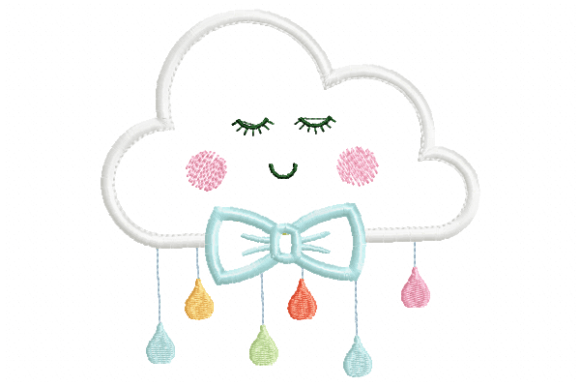
Cloud Boy: A Gentle, Versatile Embroidery Design Worth Your Thread
As a designer who’s stitched hundreds of machine embroidery designs onto everything from organic cotton onesies to heavyweight denim tote bags, I approached Cloud Boy with quiet curiosity—not hype. It’s not flashy, but it carries a soft, grounded charm that feels rare in boys’ embroidery: warm, unhurried, and quietly expressive. The moment I opened the file, I didn’t see “cute baby motif.” I saw a design that breathes—literally and visually—with open negative space, gentle curves, and balanced proportions.
First Impressions: Mood Over Mechanics
Cloud Boy lands like a sigh of relief. Its shape is compact but not cramped—rounded edges, no sharp corners or fussy outlines. The boy figure sits comfortably inside the cloud outline, arms relaxed, face simple but kind. There’s no exaggerated grin or cartoonish energy; instead, it leans into serenity. That makes it unusually flexible: it reads as sweet without being saccharine, gendered without being prescriptive, and nostalgic without feeling dated.
This isn’t an applique design demanding bold fabric contrast or heavy backing. It relies on clean satin stitch for contours and thoughtful fill stitch for subtle dimension—no dense, heat-trapping clusters. That means it won’t overwhelm lightweight fabrics or buckle under repeated washing. As a result, Cloud Boy feels like a design made *for* real life—not just for screen previews.
Where It Shines (and Where It Asks for Thought)
I tested Cloud Boy across three real projects: a linen tea towel for a boutique kitchen line, a 100% cotton baby blanket for a friend’s newborn, and a custom embroidered sweatshirt for a local preschool teacher’s gift. In each case, the design held up—not perfectly, but honestly.
- Tote bag design: On natural canvas, Cloud Boy looked effortlessly handmade—soft enough to feel personal, clear enough to read at arm’s length. No stitch bleeding, no puckering. Paired with off-white thread on oat-colored fabric, it whispered rather than shouted.
- Baby embroidery: Stitched onto a bamboo-cotton blend onesie with tear-away + cutaway stabilizer, the design stayed flat after two machine washes. The small eyes and smile held definition—no running stitch blurring—thanks to moderate stitch density and generous spacing between elements.
- Sweatshirt embroidery: Here’s where attention matters. On fleece-backed fabric, I used medium-weight cutaway stabilizer and slowed my machine speed by 15%. The cloud’s rounded edge stayed smooth—no skipped stitches—but I’d avoid placing it directly over shoulder seams or curved hems without re-hooping carefully.
It’s not ideal for every surface. Skip Cloud Boy on ultra-thin voile without extra stabilizer—it’ll shadow or distort. Avoid tight hoop sizes under 4×4 inches unless you’re confident trimming excess cloud perimeter cleanly. And while it works on dark fabric, test thread color contrast first: light gray or heathered navy thread reads better than stark white on black, preserving its gentle tone.
What It Adds to Your Finished Product
For Etsy sellers and small shop owners, Cloud Boy quietly lifts perceived value. It doesn’t scream “handmade!”—it feels handmade. Customers notice that difference: the calmness of the shape, the evenness of the satin stitch, the absence of visual noise. That translates to longer dwell time on your listing, higher trust in your craftsmanship, and stronger gift appeal—especially for baby showers, nursery decor, or minimalist holiday embroidery.
It also supports brand consistency. Unlike trend-driven motifs that date quickly, Cloud Boy fits seamlessly into cohesive collections: pair it with simple moon or raindrop designs, or use it solo as a signature touch on aprons, pillow covers, or personalized caps. For craft fair vendors, it’s a reliable anchor—familiar enough to draw smiles, distinctive enough to stand out among generic animal or alphabet designs.
Practical Designer Notes Before You Stitch
Before committing to a client project or bulk production, do these five things:
- Test on scrap fabric—same type and weight as your final piece, with the exact stabilizer you plan to use.
- Review stitch density in your embroidery software. If fill areas look overly dense or sparse, adjust underlay or density settings—not the design itself.
- Check hoop size requirements. Even if the design fits a 4×4 hoop, confirm whether it needs full clearance or can be centered with margin.
- Inspect small details in black-and-white mockups. Does the boy’s face retain clarity against both light and dark backgrounds? Does the cloud outline stay legible at 3-inch width?
- Verify licensing before selling finished products or digital embroidery files. Since Cloud Boy is marketed for baby gifts and apparel, confirm whether commercial use is permitted—and whether resale of stitched items requires attribution or limits.
Also: don’t skip thread color testing. This design thrives on subtlety. Try muted sage, warm oat, or soft slate instead of primary colors—unless your brand voice demands boldness. And remember—Cloud Boy isn’t meant to dominate. Let it rest where it belongs: on a folded corner of a blanket, the chest pocket of a toddler shirt, or the front flap of a handmade patch.
A Design That Grows With Your Craft Business
What makes Cloud Boy more than just another boys’ embroidery file is its adaptability across audiences and applications. It works for the hobbyist stitching a one-off baby gift, the apparel decorator building a seasonal nursery line, and the digital product seller bundling themed embroidery assets. It doesn’t chase trends—it fills a quiet need: for warmth, simplicity, and sincerity in stitched form.
If your goal is to build trust through thoughtful execution—not just fast output—Cloud Boy earns its place in your working library. Not as a novelty, but as a reliable, resonant tool. Use it where softness matters most. Stitch it where care is the message.